
For years on end, one of paleontology’s biggest mysteries has been the existence of Nanotyrannus, a genus of tyrannosauroid dinosaurs we now know to be discrete. The initial consensus surrounding Nanotyrannus states that the carnivore in the well-renowned fossil, “Dueling Dinosaurs” (which depicts a small tyrannosaur attacking a Triceratops), was actually a juvenile T. rex. Similarly, in 1942, a tiny tyrannosauroid skull was discovered in Montana’s Hell Creek Formation. It was first thought to be a Gorgosaurus, another relative of the T. rex. In short, many paleontologists disputed the existence of Nanotyrannus and instead argued that the fossils discovered were pre-existing tyrannosauroids, which we now know is not the case.
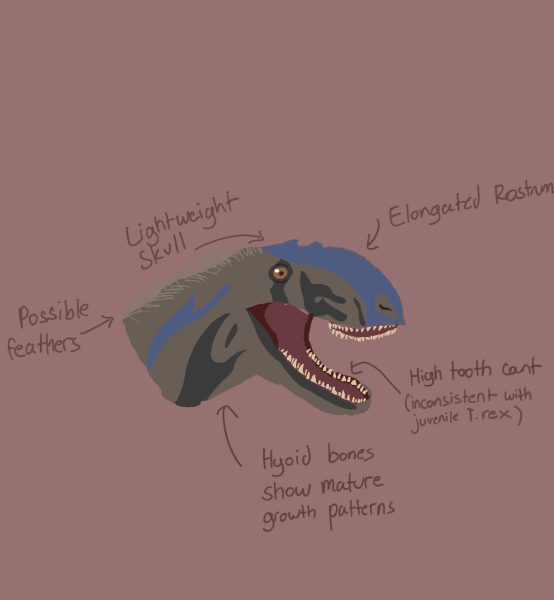
In late 2025, two separate studies served as a major turning point in our understanding of the Nanotyrannus. One study published in the journal Science used a unique technique, namely hyoid analysis. The hyoid is a much smaller bone comparatively to limb bones (which is often standard for bone analysis but often a missing component of many fossils) that lies deep in the throat. Analysis of microscopic growth patterns in the hyoid led scientists to track how the animal grew over time, like counting the rings of a tree (a common determinant of tree age).

“This is the first direct determination of maturity for the holotype specimen, the specimen that holds the name Nanotyrannus lancensis and defines the species,” said Dr. Christopher Griffin, lead author of the Science paper and assistant professor of geosciences at Princeton University. “The holotype itself represents a mature individual, and therefore cannot belong to an immature T. rex as had often been interpreted in the past.”
The importance of this shift has truly proved to be revolutionary. Small tyrannosaur fossils were often forced into the growth series of a T. rex, primarily because it was easier than creating a discrete genus. “Paleontologists had no way to confirm whether the Cleveland skull had reached skeletal maturity” said Dr. Caitlin Colleary, senior author from the Cleveland Museum of Natural History. “One small, overlooked bone proved to be the missing piece.” The hyoid evidence is just one of the many reasons as to why the Nanotyrannus was a discrete taxon. The dinosaur’s skeleton represents a longer snout, limb proportions inconsistent with known T. rex growth stages, alongside more teeth, all serving as evidence as to why the Nanotyrannus was NOT a juvenile T. rex.
“It’s great to confirm that our Nanotyrannus was fully grown,” said Colleary. “It’s also really exciting to have contributed a new tool (hyoid age dating) to the field of vertebrate paleontology. Museum collections have such an important role to play in making these types of discoveries.”
Paleontology is seldom conclusive, and this debate isn’t settled just yet, but the evidence has caused a dramatic shift in paleontological analyses. Many other small-bodied dinosaurs might represent discrete species rather than juvenile forms of bigger dinosaurs, something scientists are widely reconsidering. Ultimately, this isn’t about a debate among scientists or a singular bone, rather that scientific consensus can be altered when new methods are introduced.
Because in the end evidence points to the fact that…
The king of dinosaurs never ruled alone.