Most high school students are familiar with late nights spent studying, scrolling on their phones, or finishing homework. While sleep is known to be essential for brain development, memory, and learning, many teenagers struggle to get enough rest during the school week. During adolescence, natural changes in circadian rhythm cause teens to feel tired later at night and wake up later in the morning. This biological shift often conflicts with early school start times, leading to chronic sleep deprivation among students. This small study seeks to understand to what extent does sleep and napping really impact academic performance.
Because sleep plays an important role in attention, memory, and academic performance, I wanted to explore how sleep habits affect high school students. In particular, I examined how nighttime sleep duration relates to GPA and whether daytime napping changes that relationship.
To answer this question, I conducted an anonymous survey that was completed by 84 high school students in grades 9 through 12. This survey asked students to self-report their average nighttime sleep duration, whether they took after-school naps and how long those naps lasted, and their GPA range. Students were also asked about factors such as tiredness during school and device use before bedtime. All responses were voluntary, anonymous, and self-reported.
Students were grouped into three categories based on their napping habits: students who did not take naps, students who took naps for less than one hour, and students who took naps for more than one hour. Average GPA was then compared across different sleep durations within each group.
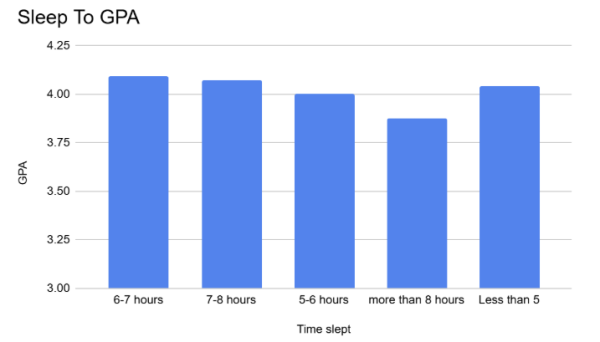
When looking at all responses together, students who reported sleeping 6–7 hours per night had the highest average GPA, while students sleeping more than eight hours had the lowest average GPA (Figure 1). However, clearer patterns emerged when students were separated by napping behavior.
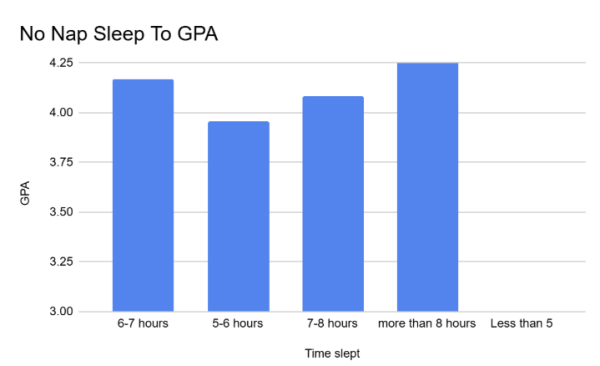
Among students who did not take after-school naps, longer nighttime sleep was associated with higher academic performance. Students sleeping more than eight hours had the highest average GPA in this group, while those sleeping 5–6 hours had the lowest (Figure 2). Notably, no students who slept fewer than five hours reported skipping naps entirely.
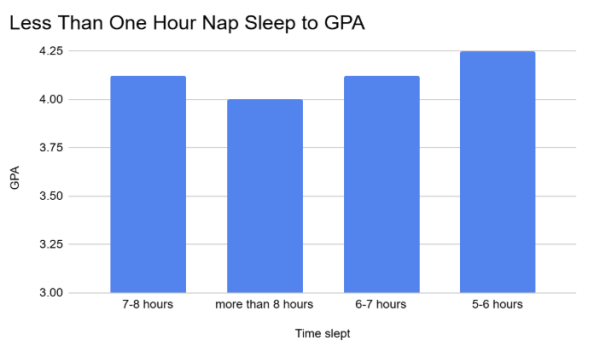
Different trends appeared among students who took short naps lasting less than one hour. In this group, students sleeping 5–6 hours at night had the highest average GPA, while those sleeping more than eight hours had the lowest (Figure 3). Despite these differences, average GPA remained relatively high across all sleep groups.
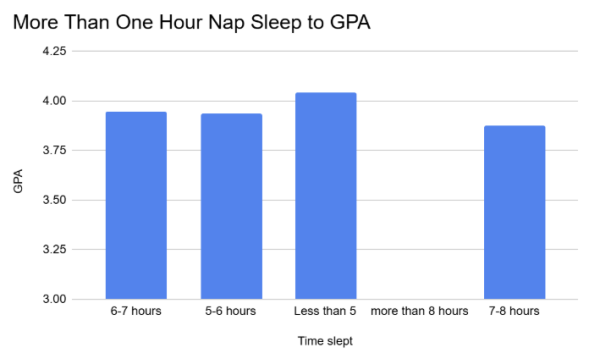
For students who took naps longer than one hour, overall academic performance was lower compared to the other groups. In this category, students sleeping fewer than five hours had the highest GPA, while those sleeping 7–8 hours had the lowest (Figure 4). No students in this group reported sleeping more than eight hours at night, suggesting that long naps may be used to compensate for significant sleep loss.
These results suggest that the relationship between sleep and academic performance is more complex than sleep duration alone. Among students who do not nap, longer and uninterrupted nighttime sleep appears to support stronger academic outcomes. However, for students who experience shorter nighttime sleep, brief naps may help restore alertness and maintain performance.
Short naps under one hour may serve as a helpful strategy for students managing heavy workloads, sports, or extracurricular activities, while longer naps may interfere with nighttime sleep or signal ongoing fatigue. While this survey cannot determine cause and effect, the findings highlight the importance of balanced sleep habits and suggest that both nighttime sleep and daytime napping should be considered when discussing student academic performance.
As high school students continue to juggle academics, activities, and personal responsibilities, understanding how sleep habits affect learning can help students make informed choices about rest and time management.
If you are interested in exploring the scientific basis of this experiment and works cited, check out the document below! (Link to the full paper)
https://docs.google.com/document/d/1tb-HsToAiIgXeV8zBDqwAikkGYCoydyp6pgIpiAzUU8/edit?usp=sharing