Math, Science, History, and English. These are the basic academic subjects for a middle schooler at BHA. In high school, however, students are offered a larger variety of classes to take depending on what they want to gain and their future plans, including many AP, or Advanced Placement, classes. AP classes are standardized classes created by the College Board that allow high schoolers to learn at a university-level pace, and potentially gain college credit depending on how they do on their comprehensive AP exams at the end of the year. BHA offers multiple AP courses. But what do you learn in these classes, and should you take them?
In high school, science is divided into three categories: Biology, Chemistry, and Physics. While the latter doesn’t have an AP class at BHA yet (though there is talk about it next year), AP Bio and AP Chem are courses high schoolers can take. I [AK] took AP Biology in my sophomore year, and it was one of my best decisions. I always knew I wanted to go into pre-med, and AP Biology was the most informative class I took at BHA. From cellular processes to ecosystems, AP Biology is a course that stays with you. What makes AP Bio different from regular biology? It goes in depth on processes, and the stimulus questions and free-response practice reinforce those concepts instead of just requiring memorization. The material was straightforward, but not quick. I spent about 6 hours studying for each unit test, and some questions were tough. The actual exam, though, was not as bad. I recommend this course to those interested in pre-med, comfortable with self-study, and up for a challenge.
Now, as a junior, I [AK] am taking AP Chemistry. At the time of writing this, my exam is in 8 days. This course is not your average science class; it’s concept-heavy and math-based, using algebra in almost every unit. The toughest unit was acids, bases, and titrations. Mrs. Mayyadah is very lenient, and her class is well organized. You always know what’s happening thanks to her online schedules and clear expectations. If you take AP Chem, here’s what a day looks like: you study the lessons the night before so you can follow along in class. Then, you work on the packets, which are great practice. Sometimes, there’s a lab. I enjoyed them all, as they were both informative and fun. I recommend this class for anyone wanting to experience a realistic college-level course. Tip: never copy or use AI on the packets; they are essential for mastering the material. Another class is AP Psychology, which is classified as an elective instead of a science, but deals with the science of the brain. I [HS] took it in sophomore year and personally enjoyed it, as it made me realize I was interested in pursuing psychology later on; however other students who don’t necessarily like the subject that much still think of the class as relatively easy. The course is quite vocab-centric, but many of the concepts are self explanatory. Still, some memorization goes into remembering all of the different theories of psychology.
Humanities classes such as history and English also have their AP equivalents. In ninth grade, many students take their first AP: AP Human Geography. This is a course that I [AK] took in my freshman year at BHA. Although it was my first AP class, Ms. Shamsa did a great job introducing us to the AP style so on test day, none of us would feel lost. This course is memorization heavy and focuses on understanding processes, with of course, an example for each one. Be expected to talk about human demographics of each country and how political boundaries affect populations. The FRQs were not hard and the actual exam was way easier than the class practice exams. Overall, APHUG is one of the easiest AP classes offered at BHA. In sophomore year, the AP history class is World History, which is a broader course on world events from c. 1200 CE to the present. Instead of smaller details, it focuses on overall global trends and putting specific events into context, which can make it easier to study compared to AP US History. However, this makes the DBQs (document based questions), and LEQs (long essay questions) a little harder as they could draw on any major event in world history. In junior year, students have the option to take APUSH, or AP US History. I [AK] am currently taking APUSH as a junior. This course is not so much memorization of specific dates or people, but more of a broader overview of the processes that shape those events. A lot of the questions are stimulus-based, which means an excerpt of a passage or a picture is present, and you will be asked to identify the events that shaped or encouraged the argument being made. Ms. Bana does a wonderful job of going over each lesson in depth every class, so you never feel lost. On the exam, you will have DBQs, LEQs, and SAQs (short answer questions) along with MCQs (multiple choice questions). This may sound overwhelming at first, but with enough practice, it is definitely possible to achieve a good score.
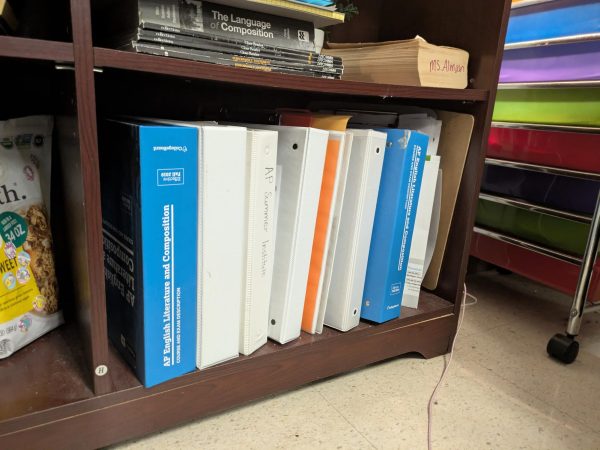
Juniors can also take AP English Language and Composition, which is primarily about analyzing nonfiction texts and writing synthesis, rhetorical analysis, and argumentative essays. This course requires reading a lot of excerpts of essays, speeches, and one or two full-length nonfiction books, and is heavy on analysis. Additionally, a lot of essay practice is needed to prepare for the AP exam, where students need to write three timed essays. However, the rhetorical analysis and writing skills acquired from this class are useful to have, even beyond the course. The other AP English class in BHA, offered in 12th grade, is AP English Literature and Composition, and since we [HS and AK] are still juniors, we interviewed senior Nawal Iqbal. “I think AP Lit is an amazing class with an amazing teacher; Mrs. A definitely helps you with templates and tips that help you during your exam. She will always hold you accountable to the work you need to get done and in good faith as well. She truly does want all of her kids to do well and she makes it so that every analysis and commentary structure you learn and the exact ones you will need to be writing about on the day of your exam.” However, she also talks about some difficulties she faced in the class. “The structure of the course is a little hard to get a hang of, especially if you haven’t taken AP Lang, though it isn’t impossible. Do not think that just because you took Lang you’ll do amazing in Lit. In all honesty the biggest problem I faced was holding myself accountable for the consistent and quantitative work load. The course is structured so that you need to be reading constantly while also doing practice; poems, commentary, and analysis. These are all constant ideas jumping through your brain while taking the course.”
Finally, juniors and seniors are eligible to take AP math classes as BHA, namely AP Precalculus and AP Calculus. Compared to the Honors Precalculus class other juniors take, the AP version covers less material, but goes more into more depth with specific material. Regarding difficulty, it isn’t much harder than honors, though AP students do have to worry about the notorious AP exam in May. Seniors can opt to take AP Calculus, although Zeina Elhamadany, a junior, takes it as well and praises it highly. “Mrs. Sophia is a phenomenal teacher who prepares you well for the course, which I find interesting itself. In AP Calc you learn the derivation of everyday formulas and why they work, so for example you learn the relationship between the formula for the volume of a sphere and its surface area, and there’s actually a connection that you learn about, which is so mind-boggling,” she said. When asked about the cons, she said, “I wouldn’t say there are any. If you’re taking the class just for the GPA boost you probably won’t enjoy it as much, though, because it is a difficult class if you’re not paying attention constantly…The way AP Calc works is that you keep building on concepts you learn at the beginning of the year. Tests are basically summative because the concepts you learn build up on each other, meaning you need to know every single concept. If you aren’t paying attention for a couple of class periods, you aren’t going to easily learn later concepts.”
Finally, similar to AP Psychology, AP Computer Science is an elective course at BHA, though some mathematical knowledge is required for it. Though neither of us [HS and AK] take this class, another junior, Zaynab Kazi, said, “It’s a good base class to be in to see if you’re interested in computer science. I’m glad I took it because I learned a lot about the basics of how to make an app function, how to debug and code, and procedures. I would advise people to take this course if they’re interested in computer science or if they want to explore it, because that’s why I took it and I was able to realize it wasn’t for me.”
In summary, BHA offers a wide range of AP courses that give students the opportunity to challenge themselves, explore their academic interests, and prepare for college-level work. Whether your passion lies in science, humanities, math, or technology, there is likely an AP class that will both push and inspire you. These courses require dedication and effort, but the skills, knowledge, and sense of accomplishment you gain are well worth it. If you are considering taking an AP class, reflect on your interests and goals, seek advice from teachers and peers, and don’t hesitate to step out of your comfort zone. The experience may be rigorous, but it will undoubtedly help you grow as a student and as a person.